November 19th, 2013

Today, Dr. Thomas Shipley and our team thought we would offer a few tips for our patients currently undergoing orthodontic treatment. For those of you wearing braces, it’s important to be even more dedicated to good oral hygiene than those not currently in treatment.
After getting your braces, it is important to know how to take care of your teeth in order to ensure that your braces stay intact and do their job so that your teeth are in top-notch condition after you complete your orthodontic treatment.
Braces are known to trap food, which contributes to plaque formation. If it is not carefully removed from the teeth and gums, plaque will develop into decay or gum disease, leading to costly delays during your treatment. It is important to practice good oral hygiene by following instructions from Dr. Thomas Shipley during your treatment.
We are proud to offer supplies to help fight plaque, such as a proxabrush, dental floss, and floss threaders. The use of an electric toothbrush and or a water pick can also be helpful in combating cavities and decay. And, of course, our team at Shipley Orthodontics suggests brushing at least twice a day.
We hope that helps! If you have any questions, please give us a call at our Peoria, AZ office or ask us during your next adjustment appointment!
November 12th, 2013

Patients at Shipley Orthodontics often wonder if lingual braces require the same amount of care as regular braces. The only real difference between lingual braces and traditional braces is the location of the brackets: lingual brackets are mounted on the back of your teeth. This mounting technique means that your braces completely hidden! However, you need to take special care of your lingual braces to prevent damage to the brackets and wires.
General care
Wearing lingual braces requires more caution when you eat hard or crunchy foods, which should be avoided whenever necessary. Applying excess pressure when you chew can cause brackets to break loose. This is more likely to happen if your upper front teeth overhang your lower teeth. You should also avoid foods that become caught in the brackets.
Brushing and flossing
Flossing can be done with a combination of regular dental floss and an inter-dental or wire brush. Floss threaders can also be used to get floss under the wires of your braces; ask our team for one at your next appointment with Dr. Thomas Shipley. You should always brush and floss after every meal, because there is a greater chance of food particles becoming stuck in your braces. You can also use a mouthwash to reduce bacteria and fight plaque. As always, keep your regular dental hygiene appointments at our convenient Peoria, AZ office to make sure that no problems develop while you’re undergoing orthodontic treatment.
Many individuals have a natural habit of rubbing their tongue along the inside of their teeth, especially when a change has occurred in their mouth. This can cause soreness or small abrasions on your tongue. While they should subside within a few weeks, the use of dental wax can be helpful.
Please ask Dr. Thomas Shipley and our team any questions you may have about your new braces and how to care for them and your teeth. The better care you take of your teeth and braces now, the better your outcome will be when your orthodontic work is complete!
November 7th, 2013
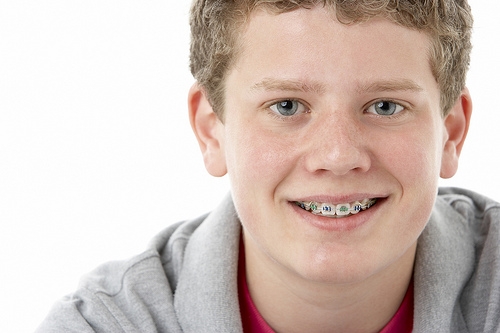
One exciting part about wearing braces from Shipley Orthodontics is getting to choose the colors of your rubber bands. Orthodontists place elastic bands, or ligatures, over each bracket to secure the archwire in place. These rubber bands may be individual or connected, depending on your mouth’s needs. From Dr. Thomas Shipley, you have the option of choosing the color of your elastics, which are changed about once every month at every visit. Our offices keep a color wheel handy to help you choose which ones suit you best!
Children and teens often enjoy picking different colors each month to express their creativity and coordinate their braces with outfits. Decorating your mouth with your favorite colors is fun for kids and takes some of the stress out of wearing braces. Adults who wish for subtlety have color options that blend in with the metal brackets and archwire. Common choices for adults include silver, clear, and gray tones.
Common Color Combinations for Rubber Bands
With individual ligatures for each bracket, you may choose different color combinations for special events. You can have alternating colors or place an entire rainbow over your teeth. Here are a few options to consider:
- School spirit colors
- Favorite sports team colors
- Patriotic colors
- Holiday themes
Some patients choose only one color to match their mood, personality, or favorite outfits. The palette of choices allows you to make bold statements with your braces or go for subtler tones that blend in with the metal structures. Keep in mind that bright colors make your teeth look whiter, while lighter shades, such as yellow and white, may cause your teeth to appear less bright.
What Your Rubber Band Color Says About You
- Red tones indicate that you are ready for action and take charge of your life with aggressive, forward-thinking steps.
- Blue tones are calm and relaxing. You are conservative and exhibit integrity when dealing with situations.
- Green tones represent growth and balance. You are level-headed and look for opportunities to grow emotionally and spiritually.
- Purple tones attract creative energies. You like to have fun and use your imagination in every aspect of your life.
- Orange tones indicate that you are optimistic and thrive in social situations where communication is open.
- Pink is a romantic color that represents a caring personality. You also enjoy having fun with silly games and endless laughter.
November 5th, 2013

The purpose of braces and other forms of orthodontic treatment at Shipley Orthodontics is to correct malocclusion, also known as crooked or crowded teeth, or “bad bites.” Past orthodontic practice dictated that wisdom teeth be removed, especially in cases of crowding.
The wisdom teeth are the last teeth to come in, and are officially known as the third molars. The teeth typically erupt, or break the surface of the skin, in young people between the ages of 13 and 20.
Sometimes, wisdom teeth are impacted. That means they cannot break through the gum tissue. This typically happens when the mouth or jaw is too small to accommodate the teeth. Impacted wisdom teeth can become infected, and some dentists and orthodontists may want to remove them as prophylaxis to prevent possible future infection.
Justification for removing wisdom teeth
Dr. Thomas Shipley will tell you that in some cases, wisdom teeth attempt to come in the wrong way, either tilting in the jaw, or sideways. If the mouth is too small to accommodate these additional teeth, they inevitably become impacted. Swelling or infection of the gum flap above an impacted wisdom tooth may cause pain. The greatest danger is pericoronitis, a potentially dangerous infection that can occur in the gum area around an impacted wisdom tooth, or around a wisdom tooth that has erupted.
Orthodontists base their decision to remove wisdom teeth on each patient's individual circumstances. To learn more about the impact wisdom teeth have on orthodontic treatment, or to schedule a visit with Dr. Thomas Shipley, please give us a call at our convenient Peoria, AZ office!


 Website Powered by Sesame 24-7™